
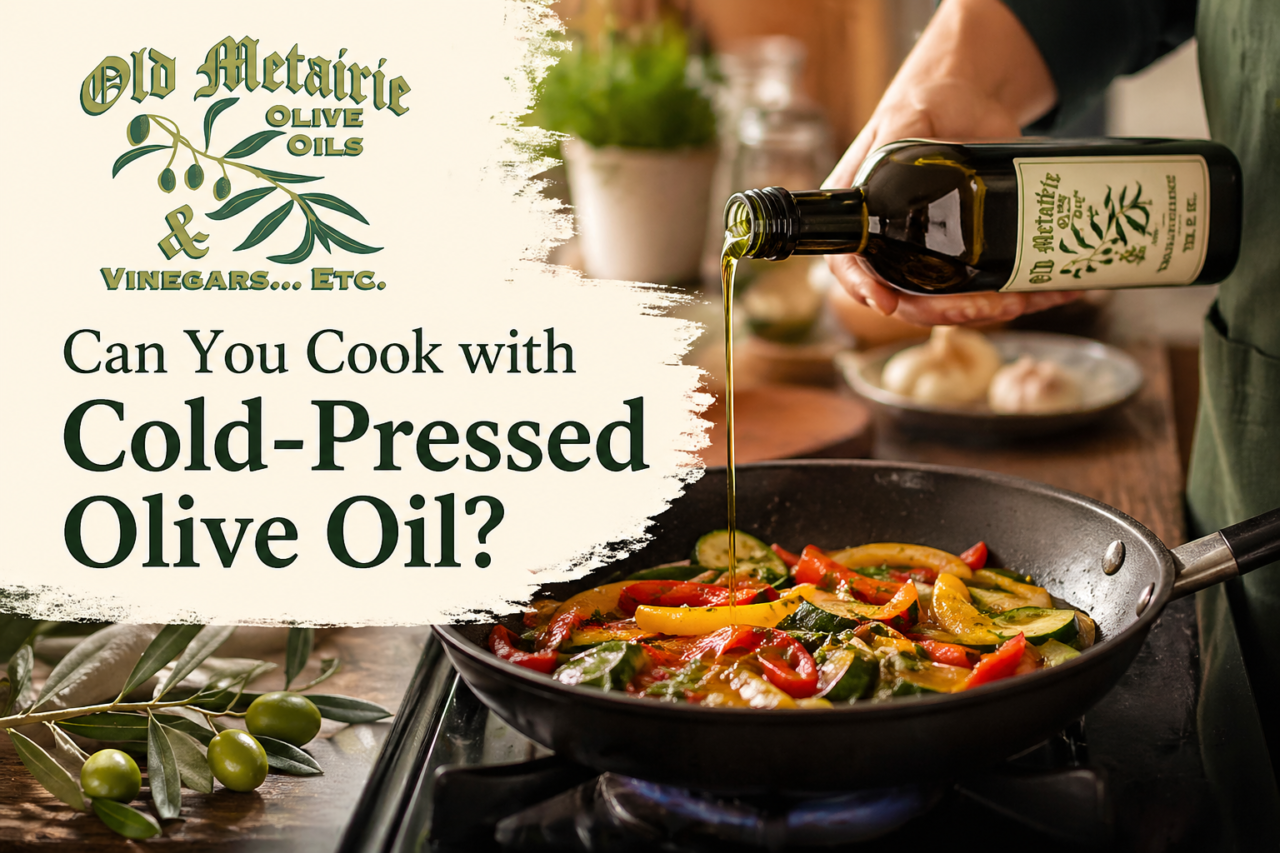
Cold pressed olive oil cooking is something a lot of people overthink — and a few people get wrong. Yes, you can absolutely use it on the stove, in the oven, and on the grill. But before you pour it over a screaming-hot skillet, there’s something worth knowing: how you use it determines whether you get the full benefit of what you paid for, or whether you cook that value right out of the bottle.
Here’s the practical answer, and what we’ve learned from carrying ultra-premium cold-pressed oils from Veronica Foods for years.
What “cold pressed” actually means
Cold-pressed olive oil is made by pressing olives at temperatures below 27°C (80°F). No heat is applied during extraction, which means the natural polyphenols, antioxidants, and delicate flavor compounds stay intact.
That matters because heat is what destroys them. A standard commercial olive oil is often processed with heat and chemicals to increase yield and extend shelf life — but the trade-off is stripped flavor and fewer health-protective compounds.
When you buy cold-pressed extra virgin olive oil, you’re buying something genuinely different from the bottle on a grocery store shelf. The question is whether cooking erases that difference.
Cold pressed olive oil cooking and the smoke point — why it’s misunderstood
You’ve probably seen the smoke point argument: cold-pressed olive oil has a lower smoke point, so you shouldn’t cook with it. This comes up constantly, and it’s only partially true.
The smoke point of extra virgin olive oil sits between 374°F and 405°F (190–207°C) depending on freshness, polyphenol content, and acidity. That’s higher than butter (302°F), coconut oil (350°F), and many other fats people cook with every day without thinking twice.
The real issue isn’t that cold-pressed olive oil can’t take heat — it’s that high heat degrades the specific compounds you’re paying for. If you overheat a $28 bottle of single-origin Coratina, you’re not ruining dinner. You’re just cooking with an expensive oil that no longer has the nutritional or flavor profile that made it worth buying.
The smoke point is the ceiling. The flavor point is well below that.
What happens to the oil at different temperatures
This is where it gets practical.
Below 250°F (120°C) — low and slow
Sautéing onions, sweating garlic, warming a sauce, finishing a soup: this is the sweet spot for cold-pressed olive oil. Heat is gentle enough that the polyphenols and volatile flavor compounds survive in meaningful amounts. This is where a good fused or infused oil — like our Baklouti Pepper or Blood Orange — can make a real difference in a dish.
250°F–375°F (120–190°C) — medium heat cooking
Pan-searing vegetables, making a vinaigrette warm, stir-frying at moderate heat: the oil handles this fine. You’ll lose some of the more delicate aromatic notes, but the core character of the oil — its pepperiness, its fruitiness, its body — holds up well. A robust variety like Coratina or Picual is well-suited here.
Above 375°F (190°C) — high heat
Deep frying, very high-heat searing: you can do it, but you’re pushing against the smoke point and the oil’s investment. For these uses, a more neutral oil makes more economic sense. Save the good stuff for lower heat and finishing.
The best uses for cold pressed olive oil cooking
Finishing — where it shines most
Drizzling cold-pressed oil over finished food is where its flavor and nutrition make the biggest impact. Over grilled fish, roasted vegetables, fresh pasta, a bowl of hummus, a caprese salad — nothing is lost to heat. Everything you paid for ends up on the plate.
A high-polyphenol oil like a fresh-harvest Cobrançosa has a noticeable peppery finish that you’d lose completely if you cooked it at high heat. Finishing preserves that.
Salad dressings and marinades
No heat involved. The oil’s flavor is fully present and does the work it was designed to do.
Bread dipping
This is the zero-heat use case, and it’s where a great oil is most immediately obvious. The difference between a grocery-store olive oil and a fresh-pressed single-origin Arbequina in a simple bread dip is something most people notice immediately, even without being told what they’re tasting.
Low and medium heat cooking
Sautéing, roasting at moderate oven temperatures (325–375°F), making pan sauces, wilting greens — all good uses. The oil performs well and contributes flavor that neutral oils never could.
Baking
Cold-pressed olive oil is excellent in baked goods: olive oil cake, focaccia, savory muffins, roasted vegetable galettes. Oven temperatures for baking typically fall in the 325–375°F range, well within the oil’s tolerance.
Which cold pressed olive oils are best for cooking vs. finishing
Not every oil in our store is designed for the same job.
Better for cooking (robust, high polyphenol):
Coratina, Picual, Koroneiki — these are peppery, intense oils with higher natural antioxidant content. They hold up better to heat and still taste like something after cooking.
Better for finishing and raw applications (delicate, fruity):
Arbequina, Cobrançosa, early-harvest Hojiblanca — more delicate aromatics that you want to keep away from significant heat. Let these do their work as a finishing drizzle.
Fused and infused oils — mostly finishing:
Our Blood Orange, Lemon, Baklouti, and Butter Olive Oils are at their best as finishing oils, in dressings, or in baking where temperatures don’t exceed 350°F. At high heat, the flavor compounds that make them special are the first things to go.
What the research actually says
The concern about cooking with extra virgin olive oil is often overstated. A 2018 study published in ACTA Scientific Nutritional Health tested 10 different cooking oils and found extra virgin olive oil produced the lowest levels of harmful polar compounds when heated — outperforming refined olive oil, coconut oil, canola, and grapeseed oil.
The polyphenols in cold-pressed oil don’t just survive moderate heat — they appear to act as a buffer against the kind of oxidative breakdown that makes other oils less stable when cooking.
This doesn’t mean you should deep-fry everything in your best single-origin oil. But it does mean the folk wisdom about olive oil being “dangerous” to cook with is not supported by the evidence.
The practical rule
If you want a simple guideline: use cold-pressed olive oil for everything up to medium-high heat, and use it liberally as a finishing oil. Reserve the most delicate, expensive bottles for raw applications and finishing. Use a more robust variety for everyday cooking.
What you should not do is buy a quality cold-pressed oil and never use it out of fear of wasting it. An oil used is doing its job. An oil sitting on a shelf past its freshness window is the actual waste.
How to know if your oil is fresh enough to cook with
Here’s something that matters more than the variety or the price: freshness. Cold-pressed olive oil oxidizes over time, and an old oil — even one that started as premium — has already lost most of what made it worth buying.
At Old Metairie, every oil we carry comes from Veronica Foods and is tested for free fatty acid levels, peroxide values, and polyphenol content before it reaches our shelves. You’re not guessing. You’re getting something that’s verified fresh.
An oil with high peroxide values is already oxidized — it’s been compromised before you even open the bottle. This is the hidden problem with most grocery store olive oils, and it’s why the chemistry matters.
If you want to understand more about what we test for and why it matters, take a look at our chemistry page.
FAQS
Can you cook with cold-pressed olive oil?
Yes. Cold-pressed extra virgin olive oil has a smoke point between 374°F and 405°F, making it suitable for sautéing, roasting, baking, and medium-heat cooking. For high-heat frying, a more neutral oil is a better choice economically, but cold-pressed olive oil handles everyday cooking very well.
Is cold-pressed olive oil good for cooking?
Yes. Cold-pressed olive oil is stable at moderate cooking temperatures and outperforms many other oils in studies measuring harmful compounds produced during heating. Its high polyphenol content also provides some protection against oxidative breakdown.
What is the smoke point of cold-pressed olive oil?
Cold-pressed extra virgin olive oil has a smoke point between 374°F and 405°F (190–207°C), depending on freshness and polyphenol content. This is higher than butter, coconut oil, and many other common cooking fats.
Can you fry with cold-pressed olive oil?
You can shallow-fry with cold-pressed olive oil at moderate temperatures. Deep frying requires sustained temperatures near or above the smoke point, where the oil’s delicate compounds degrade. For deep frying, a neutral oil is more economical, but cold-pressed olive oil is not unsafe for frying at moderate heat.
What is cold-pressed olive oil best used for?
Cold-pressed olive oil is excellent for finishing dishes (drizzled over finished food), salad dressings, bread dipping, baking, and low-to-medium heat cooking. Its flavor and nutritional compounds are most intact when used raw or at lower temperatures.
The bottom line
Cold-pressed olive oil is not fragile. It handles everyday cooking — sautéing, roasting, baking — well within its smoke point and with flavor that refined oils can’t match. The only thing it can’t do without losing something is high-heat frying, and for that, most cooks don’t need a premium oil anyway.
Use it. Cook with it. Drizzle it on everything. Just try not to blast it past 375°F, and use your most delicate bottles for finishing where their flavor has the most room to show up.
If you want to explore what’s in stock right now — including oils specifically suited for cooking — browse the full collection or stop in for a tasting. We’ll help you find the right oil for how you actually cook.
