
Introduction
You’ve probably heard that olive oil is good for you. But not all olive oil is created equal—and the difference lies in something most people have never heard of: polyphenols.
These powerful plant compounds are the real MVPs of extra virgin olive oil’s health benefits. They’re what make the difference between a bottle that’s simply pleasant to cook with and one that actively supports your cardiovascular health, brain function, and metabolism.
In 2026, the wellness world is catching up to what Mediterranean cultures have known for centuries. High polyphenol extra virgin olive oil isn’t just a cooking ingredient anymore—it’s being recognized as a functional food, backed by peer-reviewed research and validated by major health institutions.
If you’re serious about getting the maximum health benefits from olive oil, you need to understand polyphenols. This guide breaks down the science, shows you what to look for when shopping, and explains exactly how to use high polyphenol EVOO to support your wellness goals.
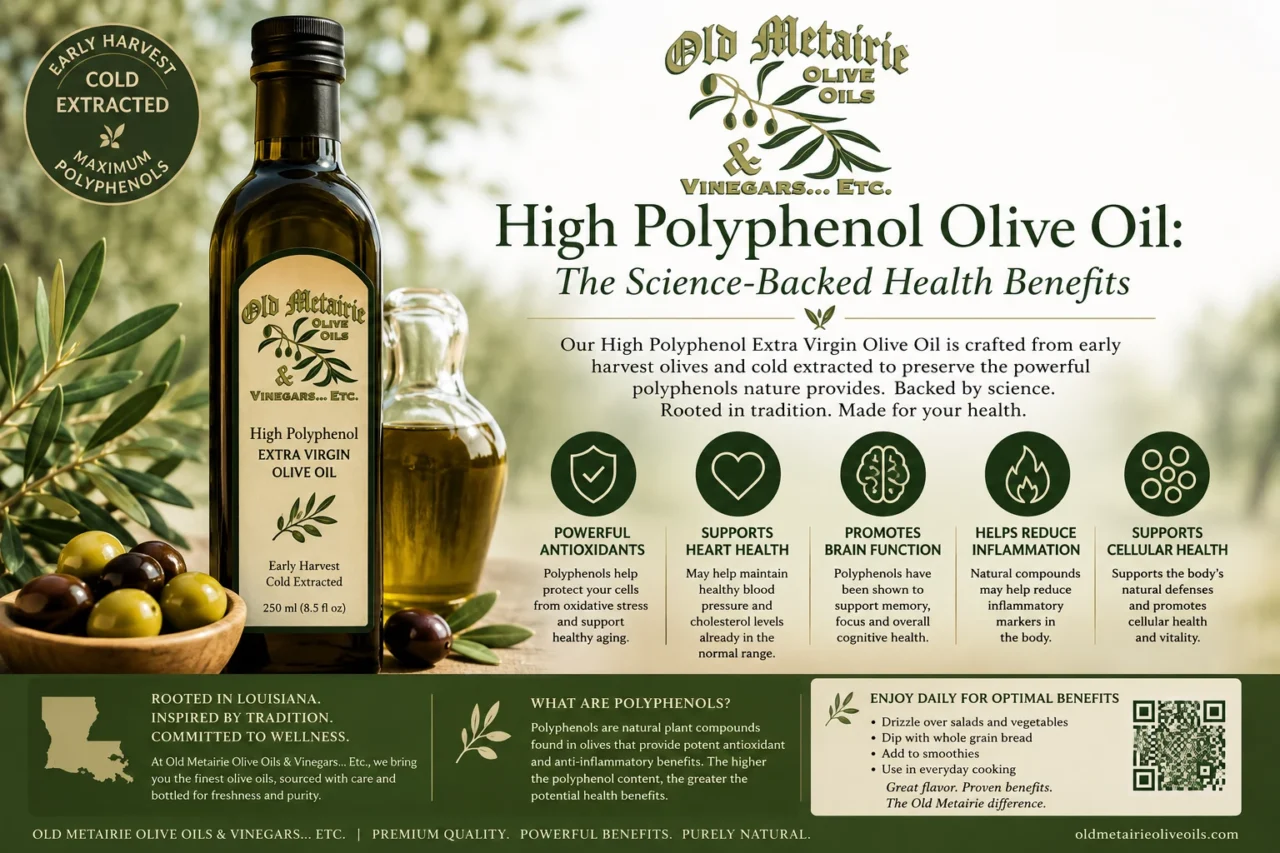
What Are Polyphenols, Really?
Polyphenols are naturally occurring plant compounds with antioxidant and anti-inflammatory properties. Think of them as your cells’ personal bodyguards—they neutralize harmful free radicals that can damage your tissue and accelerate aging.
But polyphenols in olive oil are special. While you can find these compounds in red wine, berries, and dark chocolate, extra virgin olive oil contains over 20 different types of polyphenols, each working in slightly different ways to protect your health.
The two most researched and potent polyphenols in quality EVOO are:
Hydroxytyrosol (HT): This compound is particularly praised for supporting cardiovascular health. It helps reduce inflammation and supports healthy blood pressure and cholesterol levels.
Oleocanthal: You know that peppery, throat-catching sensation when you taste a really good EVOO? That’s largely oleocanthal. This compound mimics the effects of anti-inflammatory medications and has shown promise in supporting brain health and reducing oxidative stress.
The European Food Safety Authority recognizes that olive oils containing at least 250 mg/kg of polyphenols can make health claims. But therapeutic benefits become significantly more pronounced at levels exceeding 500 mg/kg—and the highest quality, early-harvest oils can contain over 1,000 mg/kg.
That’s a dramatic difference. And it matters for your health.
The Health Benefits of High Polyphenol Olive Oil: What the Science Shows
1. Cardiovascular Health & Heart Disease Prevention
This is the most well-researched benefit, and for good reason.
Consuming extra virgin olive oil rich in polyphenols is associated with improved lipid profiles, including reductions in total cholesterol and increases in HDL (“good”) cholesterol. Polyphenols support the health of your endothelial cells—the thin layer of cells that line your blood vessels—which is critical for healthy blood pressure and blood flow.
A landmark 2025 study published in The Lancet Diabetes and Endocrinology examined over 7,000 participants following a Mediterranean diet supplemented with high-quality EVOO. The results were clear: participants who consumed the most olive oil showed better cardiovascular markers and, remarkably, more weight loss than the comparison group.
The mechanism is elegant: polyphenols reduce inflammation throughout your arterial system, support healthy blood pressure, and help prevent the oxidation of LDL cholesterol—which is what makes it dangerous to your arteries in the first place.
Bottom line: If cardiovascular health is your priority, high polyphenol EVOO is worth the investment.
2. Weight Management & Metabolic Health
If you’ve seen viral videos of wellness influencers drinking olive oil as a “weight loss shot,” there’s actually some legitimate science here—though the reality is more nuanced than the hype.
Polyphenols support weight management in several ways:
Appetite Regulation: Oleic acid, the dominant monounsaturated fat in olive oil, triggers the release of a signaling molecule called oleoylethanolamide (OEA) in your gut. This molecule tells your brain you’re full, promoting satiety and reducing overeating.
Metabolic Enhancement: Polyphenols boost thermogenesis—the process by which your body burns calories to produce heat. Studies show that consuming 2-4 tablespoons of high-polyphenol EVOO daily can enhance fat oxidation and support long-term weight management when paired with a balanced diet.
Belly Fat Reduction: Research published in 2025 specifically linked habitual EVOO consumption to lower belly fat and healthier BMI measurements, independent of other diet factors. This is significant because visceral fat (belly fat) is metabolically more dangerous than subcutaneous fat elsewhere on your body.
Important caveat: Simply adding olive oil on top of your normal diet won’t cause weight loss—olive oil contains 120 calories per tablespoon. The weight management benefits come when you substitute high-polyphenol EVOO for less healthy fats like butter, margarine, or vegetable oils.
Bottom line: Use high polyphenol EVOO as a replacement for less healthy fats, aim for 1-2 tablespoons daily in salad dressings, on vegetables, or with bread, and combine with consistent exercise and balanced nutrition.
3. Brain Health & Cognitive Protection
This is one of the most exciting emerging areas of research.
A 2024 comprehensive review found that olive oil may significantly reduce the risk of developing Alzheimer’s disease and age-related cognitive impairment. The mechanism appears to work through several pathways:
Polyphenols reduce beta-amyloid plaques inside brain cells—these plaques are hallmark features of Alzheimer’s disease. They also combat neuroinflammation and oxidative stress, both of which contribute to cognitive decline.
Additionally, olive oil supports the health of your blood-brain barrier, the critical structure that protects your brain from harmful substances while allowing nutrients to pass through.
Mediterranean populations, who consume the most olive oil globally, consistently show lower rates of Alzheimer’s disease and age-related cognitive decline compared to populations consuming Western diets.
Bottom line: If supporting long-term brain health matters to you, high polyphenol EVOO is an investment in your cognitive future.
4. Anti-Inflammatory & Antioxidant Effects
Chronic inflammation is the root cause of most modern diseases, from heart disease to diabetes to autoimmune conditions. This is where polyphenols truly shine.
The antioxidant properties of polyphenols work on a cellular level to:
- Reduce oxidative stress (an imbalance of harmful free radicals and protective antioxidants)
- Support immune function by modulating white blood cell production
- Reduce inflammation throughout your body, from your cardiovascular system to your joints
One study comparing different olive oil varieties found that Kalamata olive oil demonstrated the highest antioxidant and anti-inflammatory activity among all extra virgin olive oils tested—though this varies by harvest date and processing method.
5. Type 2 Diabetes Prevention & Blood Sugar Control
Emerging research suggests that high polyphenol olive oil may help protect against type 2 diabetes and support healthy blood glucose levels.
The mechanism involves:
- Improving insulin sensitivity (your cells’ ability to respond to insulin)
- Supporting healthy cholesterol profiles, which are closely linked to diabetes risk
- Reducing inflammation, which plays a role in insulin resistance
How to Choose High Polyphenol Olive Oil: The Buyer’s Guide
Now that you understand why polyphenols matter, here’s the critical question: How do you actually find them when you’re shopping?
This is where things get tricky. Many bottles on store shelves contain only 50-150 mg/kg of polyphenols—nowhere near therapeutic levels. Some producers don’t even measure or disclose their polyphenol content.
Here’s what to look for:
1. Polyphenol Content (Look for Lab Testing)
Reputable producers test their olive oil and publish the results prominently. Look for bottles or websites that specify:
- Total polyphenol content measured in mg/kg (milligrams per kilogram)
- Specific polyphenol compounds like hydroxytyrosol and oleocanthal
- Third-party lab verification from an accredited laboratory
Standard to know: The European Food Safety Authority requires at least 250 mg/kg for health claims, but therapeutic doses typically start around 500 mg/kg. The highest quality oils exceed 1,000 mg/kg.
2. Olive Variety
Some olive varieties naturally contain more polyphenols than others.
Kalamata olives (Greek): The clear winner for polyphenol content. Kalamata oil is intensely bitter and peppery—those characteristics signal high oleocanthal content.
Picual olives (Spanish): These produce oil with exceptional stability and strong antioxidant profiles. Widely available and excellent quality-to-price ratio.
Coratina olives (Italian): Robust and bitter, packed with polyphenols. One of the healthiest EVOO options available.
Arbequina olives: Milder flavor profile with moderate polyphenol content. Good for those new to high-polyphenol oils.
Pro tip: Don’t assume the origin country guarantees quality. What matters more is the specific olive variety, harvest timing, and processing method.
3. Harvest Date
This is critical and often overlooked.
Early-harvest olives (picked green in September/October) contain up to 60% more polyphenols than fully ripened olives harvested later in the season. This is because polyphenols naturally decline as olives mature.
A truly high-polyphenol EVOO will display the harvest date prominently on the bottle. Fresh oils from recent harvests are significantly more potent.
Current date check: If you’re reading this in 2026, look for oils from the 2025 or 2026 harvest. Oils older than 1-2 years have degraded polyphenol content.
4. Processing Method
How an olive oil is extracted dramatically affects polyphenol preservation.
Cold-pressed oils (extracted at temperatures below 27°C/80°F) preserve up to 98% of naturally occurring polyphenols. This is why “cold-pressed” isn’t just a marketing term—it’s scientifically significant.
Standard or refined olive oils, which use heat and chemical solvents, may preserve only 60-70% of original polyphenols.
Look for labels that explicitly state:
- “Cold-pressed”
- “First cold-pressed”
- “Extra virgin” (which requires cold extraction)
5. Packaging & Storage
Polyphenols degrade over time when exposed to heat, light, and oxygen.
Quality producers package their high-polyphenol oils in:
- Dark glass bottles (which block light)
- Nitrogen-flushed bottles (which displace oxygen)
- Smaller bottle sizes (so the oil is consumed quickly, at peak freshness)
Avoid oils in clear bottles or large containers meant for bulk cooking. If polyphenol content is your priority, freshness trumps value.
6. Third-Party Certifications to Trust
- EFSA (European Food Safety Authority) approved health claims: Look for language like “olive oil polyphenols contribute to the protection of blood lipids from oxidative stress” on the label.
- NAOOA (North American Olive Oil Association) seal: Indicates adherence to quality standards.
- Protected Designation of Origin (PDO) or Protected Geographical Indication (PGI): European certifications indicating specific production standards.
High Polyphenol Olive Oils Available in Louisiana
If you’re shopping locally in the New Orleans/Metairie area, sourcing premium high-polyphenol oils can be challenging. Many mainstream grocery stores stock commodity oils with minimal polyphenol content.
At Old Metairie Foods, we specialize in curating ultra-premium extra virgin olive oils selected specifically for polyphenol content and quality. Our Veronica collection includes several early-harvest, cold-pressed EVOOs from renowned producers, with transparent testing data and harvest dates clearly labeled.
We work directly with producers who prioritize polyphenol preservation over yield, meaning our oils cost more than supermarket bottles—but deliver dramatically superior health benefits.
Visit our store at 103 Focis St, Metairie, LA 70005 to taste the difference, or call us at (504) 354-1275 to discuss which oils match your specific health goals.
How to Use High Polyphenol Olive Oil for Maximum Health Benefits
Having high-quality oil is only half the equation. How you use it matters too.
Daily Consumption Guidelines
For health benefits: Aim for 1-2 tablespoons (15-30 mL) of high-polyphenol EVOO daily. This amount has been shown in studies to deliver measurable health benefits while fitting easily into a calorie-conscious diet.
For therapeutic effects: Some research suggests benefits at 2-4 tablespoons daily, though individual response varies. Consult a registered dietitian for personalized recommendations.
Best Ways to Consume It
Don’t heat high-polyphenol oils excessively. While EVOO can handle moderate cooking temperatures (up to about 380°F/190°C for sautéing), high-polyphenol oils are best used at lower temperatures to preserve delicate compounds.
Ideal uses:
- Finishing oil: Drizzle over completed soups, roasted vegetables, or grains
- Salad dressings: Base for vinaigrettes with lemon juice or balsamic vinegar
- Bread dipping: With herbs and sea salt (the traditional Mediterranean way)
- Low-heat cooking: Gentle sautéing of vegetables, not high-heat searing
- In coffee: A trending wellness practice that works—polyphenols dissolve in hot beverages
What to avoid:
- Deep frying (damages polyphenols and creates harmful compounds)
- Prolonged storage after opening (use within 3-4 weeks of opening)
- Exposure to heat and light (store in a cool, dark cabinet)
FAQ: High Polyphenol Olive Oil & Health Benefits
Q: Is high polyphenol olive oil safe for everyone?
A: Generally yes. Extra virgin olive oil is well-tolerated by most people. However, if you have a tree nut allergy or specific digestive sensitivities, introduce it gradually and consult your healthcare provider. People taking blood-thinning medications should note that olive oil has mild anticoagulant properties; discuss with your doctor if on medications like warfarin.
Q: Will high polyphenol olive oil help me lose weight?
A: It can support weight management, but it’s not a silver bullet. Polyphenols enhance metabolism and appetite regulation, but only when substituted for less healthy fats and combined with regular exercise and balanced nutrition. Simply adding olive oil to your diet won’t cause weight loss due to its calorie density (120 calories per tablespoon).
Q: How can I tell if an olive oil is actually high polyphenol?
A: Look for:
- Specific polyphenol content listed in mg/kg
- Harvest date from early-season picking (September/October)
- Cold-pressed processing method
- Dark glass packaging
- Third-party lab testing documentation
If a producer doesn’t provide this information, their oil likely doesn’t prioritize polyphenol content.
Q: What’s the difference between polyphenol and antioxidant claims?
A: All polyphenols are antioxidants, but not all antioxidants are polyphenols. “Antioxidant” is a broader category. When you see “high antioxidant” on a label without specific polyphenol data, the producer may not have measured polyphenol content specifically. Look for the more specific “polyphenol” language backed by lab data.
Q: Can I cook with high polyphenol olive oil?
A: Yes, but with limitations. High-polyphenol oils can handle sautéing at moderate temperatures (up to about 380°F/190°C), though polyphenols degrade at high heat. For maximum health benefits, use high-polyphenol oils for finishing dishes, dressings, and low-heat cooking. Reserve regular EVOO for higher-heat cooking.
Q: How much will high polyphenol olive oil cost?
A: Significantly more than supermarket oils—typically $25-$60+ per 500mL bottle, compared to $8-$15 for commodity EVOO. The premium reflects early harvesting (lower yield), specialized cold-pressing, lab testing, and smaller production volumes. Consider it an investment in health, not just cooking oil.
Q: How long does polyphenol content remain stable in an open bottle?
A: Once opened, polyphenol content begins degrading. Use high-polyphenol oils within 3-4 weeks of opening for maximum benefit. Store in a cool, dark cabinet away from the stove. Some people purchase smaller bottles specifically to use them quickly and preserve polyphenol content.
Q: Is extra virgin olive oil from Italy or Spain better for polyphenol content?
A: Origin matters less than olive variety, harvest timing, and processing. A late-harvest Spanish oil might have lower polyphenols than an early-harvest Greek oil. Focus on the specific variety and harvest date rather than assuming quality by country.
Q: Can I get high polyphenol olive oil benefits from cooking oils labeled “pure” or “light” olive oil?
A: No. Refined olive oils are extracted using heat and chemicals, which removes most polyphenols. Only extra virgin olive oil contains significant polyphenol content. “Pure” and “light” oils are fine for general cooking but won’t deliver the health benefits of high-polyphenol EVOO.
Q: Are there any interactions between high polyphenol olive oil and medications?
A: Olive oil has mild anticoagulant (blood-thinning) properties. If you take warfarin or other blood-thinning medications, discuss olive oil consumption with your doctor—you may need to adjust medication dosage. There are no known interactions with most other common medications, but it’s always wise to mention dietary changes to your healthcare provider.
High Polyphenol Olive Oil & the Mediterranean Diet: Why Context Matters
You can’t discuss olive oil health benefits without mentioning the Mediterranean diet, which has been rated the #1 healthiest diet by nutritionists for several years running.
The Mediterranean diet’s success isn’t just about olive oil—it’s a complete dietary pattern emphasizing:
- Plant-based foods (vegetables, legumes, whole grains)
- Fish and seafood (2-3 times per week)
- Moderate poultry and eggs
- Limited red meat
- Herbs and spices instead of salt
- Red wine in moderation with meals
- High-quality olive oil as the primary fat source
When researchers isolated olive oil’s specific contribution within this diet, they found that high-polyphenol EVOO consumption directly correlates with improved health markers, regardless of other diet factors.
The takeaway: While high-polyphenol olive oil is genuinely beneficial, it works best as part of an overall healthy lifestyle, not as a standalone “superfood” fix.
The Bottom Line: Is High Polyphenol Olive Oil Worth It?
If you’re asking whether premium high-polyphenol EVOO is worth the price difference, here’s an honest answer: it depends on your health priorities and budget.
High polyphenol olive oil makes sense if you:
- Have a family history of heart disease or cognitive decline
- Are actively managing weight or metabolic health
- Follow a Mediterranean-inspired diet already
- Want to optimize your daily nutrition
- Have the budget to prioritize quality ingredients
Regular EVOO is fine if you:
- Are primarily cooking with oil (cooking uses lower-quality oils)
- Have budget constraints
- Are new to olive oil and want to explore first
- Eat a generally healthy diet but don’t prioritize this specific optimization
The research is clear: High polyphenol extra virgin olive oil delivers measurable health benefits backed by peer-reviewed science. Whether those benefits justify the cost is a personal decision based on your health goals and financial situation.
What we know from Mediterranean populations is that consistent use of quality olive oil, combined with healthy eating patterns and regular activity, contributes to exceptional longevity and disease prevention.
Getting Started: Your Next Steps
- Check the polyphenol content of any olive oil you’re considering. If it’s not listed or tested, the producer probably doesn’t prioritize polyphenol content.
- Look for early-harvest oils from 2025 or 2026. Older oils have degraded polyphenols.
- Start with 1-2 tablespoons daily in salads, with bread, or on finished dishes to see how your body responds.
- Pair it with healthy habits: Olive oil is most effective when combined with whole foods, regular movement, stress management, and quality sleep.
- Consult your healthcare provider if you take blood-thinning medications or have specific health conditions.
If you’re in the New Orleans or Metairie area, visit Old Metairie Foods to sample our carefully curated selection of ultra-premium, high-polyphenol extra virgin olive oils. Our staff can help match you with oils that fit your specific health goals and taste preferences.
Store Location: 103 Focis St, Metairie, LA 70005
Hours: Tue-Fri 10:00 AM – 5:30 PM | Sat 10:00 AM – 4:00 PM | Closed Sun-Mon
Phone: (504) 354-1275
Email: hardiefrench@gmail.com
Internal Links to Add
- “Fused vs Infused Olive Oils” → https://oldmetairiefoods.com/fused-infused-olive-oils/
- “How to Spot High Quality Olive Oil” → https://oldmetairiefoods.com/how-to-spot-high-quality-olive-oil/
- “Oil Vinegar Pairings” → https://oldmetairiefoods.com/olive-oil-vinegar-pairings/
- “Premium olive oils” (first mention) → https://oldmetairiefoods.com/veronica-premium-olive-oils/
- “Ultra Premium Extra Virgin Olive Oil” → https://oldmetairiefoods.com/product-category/ultra-premium-extra-virgin-olive-oil/
- “Shop all products” → https://oldmetairiefoods.com/shop-all-products/
External Links
- European Food Safety Authority polyphenol claims: https://www.efsa.europa.eu
- North American Olive Oil Association: https://www.aboutoliveoil.org
- The Lancet Diabetes & Endocrinology (2025 Mediterranean diet study): https://www.thelancet.com
- NIH/NCBI Polyphenol Health Research: https://www.ncbi.nlm.nih.gov/pmc/articles/PMC5877547/
- Healthline: 11 Proven Benefits of Olive Oil: https://www.healthline.com/nutrition/11-proven-benefits-of-olive-oil
