
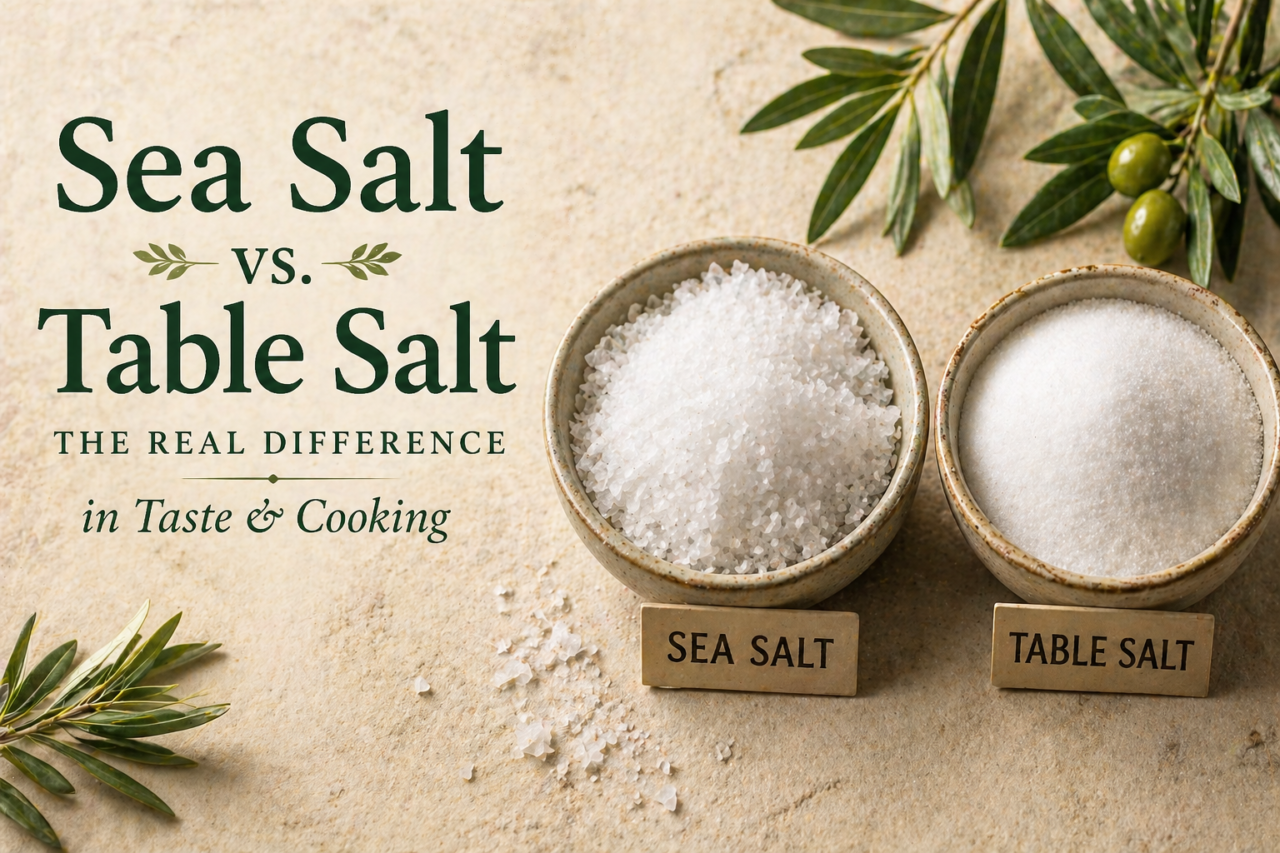
The sea salt vs table salt question is one that seems simple and turns out not to be. Yes, they’re both sodium chloride. Yes, they both make food taste saltier. But if you’ve ever finished a dish with a pinch of good flaky sea salt and noticed something different — a brightness, a crunch, a flavor that lingers — you already know the answer. They taste different.
The reason why is worth understanding. It changes how you cook and when each type of salt earns its place.
What table salt actually is
Table salt is mined from underground salt deposits, then heavily processed to remove minerals and impurities. Manufacturers add iodine — a public health measure introduced in the 1920s to prevent iodine deficiency. They also add anti-caking agents to keep it from clumping.
The result is a highly refined product: uniform, fine-grained, intensely salty, and essentially pure sodium chloride. It does its job well. However, the processing strips out the trace minerals that give unrefined salts their more complex flavor.
When you taste table salt directly, it hits sharp and fast — a one-note, harsh salinity that many people find aggressive. Because the grains are so fine and uniform, it dissolves quickly. That makes it reliable for baking and precise seasoning.
What sea salt actually is
Sea salt is made by evaporating seawater — either through sun and wind in open-air pans, or through controlled evaporation. The process is slower and less refined, which means more of the naturally occurring trace minerals survive: magnesium, calcium, potassium, and others depending on the water source.
Those minerals are what make sea salt taste different. They don’t just add flavor. They modulate the sharpness of the sodium, round out the salt’s profile, and give it a more complex finish. As a result, sea salt from different regions tastes genuinely different from each other — much like olive oils from different estates.
Why the source matters
A sea salt from the coast of Sardinia tastes different from one harvested off the coast of Brittany or the shores of Hawaii. The mineral composition of the water, the evaporation method, and any additional processing all shape the final flavor.
This is why specialty sea salts — like the Sardinian salts we carry from Veronica Foods — have a genuinely distinct character. They’re not just “saltier.” They have depth, a particular texture, and a finish that table salt simply doesn’t produce.
Does sea salt actually taste different — or is it just texture?
This is the real debate, and the answer is: both.
Texture plays a bigger role than most people realize. Flaky or coarse sea salt delivers salt in concentrated bursts. A single flake on the tongue registers as a distinct hit of salinity, followed by a more complex mineral finish. Fine table salt distributes evenly and dissolves immediately, giving you uniform saltiness without that layered experience.
Mineral content adds genuine flavor. In blind taste tests, tasters consistently detect a difference between refined and unrefined sea salt — even when grain size is controlled for. The trace minerals in unrefined sea salt contribute subtle sweetness, mild bitterness, and a rounder overall flavor that refined salts lack.
The iodine factor
Iodine affects taste. The iodine added to table salt has a faintly metallic, slightly bitter aftertaste that many people have simply gotten used to. Remove it — as in non-iodized sea salt — and the salt tastes cleaner.
So yes: good sea salt genuinely tastes different from table salt, for reasons beyond texture alone.
Sea salt vs table salt in cooking
The right salt depends on what you’re doing in the kitchen. Understanding the sea salt vs table salt distinction helps you get more from both.
When table salt makes more sense
Baking. Recipes are calibrated for fine-grain salt. A teaspoon of table salt and a teaspoon of flaky sea salt contain very different amounts of actual sodium — the flaky salt has more air and less sodium per volume. Consequently, using a coarse sea salt in baking without adjusting quantities can under-season your recipe.
Boiling water for pasta or vegetables. You’re using a large quantity and the salt dissolves immediately. Fine table salt or kosher salt is efficient and economical here. There’s no textural or flavor payoff that justifies using a premium sea salt in a pot of boiling water.
Precise seasoning during cooking. When you need to control salt levels carefully — in sauces, braises, or soups — fine-grain salt is easier to measure and dissolves predictably.
When sea salt makes more sense
Finishing. This is where sea salt earns its price. A pinch of flaky sea salt over a finished steak, roasted vegetables, or scrambled eggs does something table salt simply can’t. It adds textural contrast, a burst of salinity, and mineral complexity that makes the dish taste more complete. This is the number one use case for a quality sea salt.
Bread dipping. A small dish of cold-pressed olive oil with a pinch of good sea salt is one of the simplest and best things you can put on a table. The salt dissolves slowly in the oil, seasoning it gradually rather than all at once.
Grilling and roasting. Larger salt crystals on the surface of meat before cooking create a crust during the Maillard reaction — the browning process — that fine salt doesn’t produce as effectively. The slower dissolving of coarse sea salt also means the seasoning penetrates gradually rather than drawing out moisture.
At the table. A small dish of flaky sea salt for guests to finish their own plates is a simple upgrade that signals attention to detail. It also lets people control their own seasoning, which most people appreciate.
Kosher salt vs sea salt — what’s the difference
Kosher salt comes up in nearly every recipe these days. It’s worth understanding how it fits into the sea salt vs table salt picture.
Kosher salt is not sea salt. Producers mine it from the same underground deposits as table salt but process it differently — leaving it in larger, flakier grains without added iodine. The name comes from its use in koshering meat, where the larger grains draw out blood more effectively than fine salt.
In terms of flavor, kosher salt is cleaner than iodized table salt because it lacks the iodine aftertaste. However, it’s still a refined sodium chloride without the mineral complexity of a good unrefined sea salt.
The practical difference: Kosher salt is the workhorse for everyday cooking — easy to pinch, easy to control, no iodine taste, reasonably affordable. Sea salt, particularly unrefined varieties, is better suited for finishing and applications where flavor complexity matters. In addition, specialty sea salts like herbed or smoked varieties add a dimension that neither kosher nor table salt can replicate.
The Seasonello salts — what makes them different
At Old Metairie, we carry a line of Italian sea salts from Seasonello, sourced through Veronica Foods. These are worth knowing about because they represent a different category entirely from both table salt and plain sea salt.
Sardegna Fine Sea Salt is harvested from the waters off Sardinia — a region known for particularly clean, mineral-rich Mediterranean seawater. Producers grind it finely, making it a direct substitute for table salt in any application but with a noticeably rounder flavor. It contains no additives, anti-caking agents, or added iodine.
Herbal Sea Salt blends Sardinian sea salt with dried Italian herbs — rosemary, sage, and others — creating an all-in-one seasoning that works beautifully on roasted meats, vegetables, focaccia, and pasta. It’s one of the most used products in our store.
Spicy Aromatic Salt combines sea salt with chili, garlic, and aromatic herbs. It works as a finishing salt on grilled meats, pizza, and eggs, and as a seasoning during cooking wherever you want salt and heat in the same pinch.
These aren’t flavored salts in the novelty sense — they’re practical, daily-use products that replace table salt in most cooking applications while adding more flavor in the process.
How salt enhances flavor — the science in plain language
Salt doesn’t just make food taste saltier. It changes how we perceive other flavors, and understanding this explains why the quality of your salt matters more than most people expect.
Salt suppresses bitterness. This is the most counterintuitive effect. Research from the Monell Chemical Senses Center shows that sodium ions block bitter taste receptors, which is why a pinch of salt in coffee or dark chocolate makes it taste less bitter and more balanced. It’s also why salted butter tastes different from unsalted — the salt isn’t just adding flavor, it’s removing something unpleasant.
Salt amplifies sweetness and savoriness. By suppressing bitterness and enhancing the perception of other flavors, salt makes sweet things taste sweeter and savory things taste more savory. This is why a properly salted dish tastes more fully developed than an under-salted one — it’s not about saltiness, it’s about flavor amplification.
Mineral complexity adds its own flavor. The trace minerals in unrefined sea salt — magnesium, calcium, potassium — each have their own mild flavor contributions that add to the overall profile. The result is a salt that seasons and adds character simultaneously.
A good finishing sea salt leverages all three of these effects at once. It’s why chefs reach for flaky sea salt at the end of cooking rather than table salt — not for show, but because it genuinely tastes better.
FAQS
Does sea salt taste different than table salt?
Yes. Sea salt tastes different from table salt for two main reasons: texture and mineral content. Flaky or coarse sea salt delivers salt in concentrated bursts with a more complex, lingering finish. Unrefined sea salt also contains trace minerals — magnesium, calcium, potassium — that give it a rounder, more nuanced flavor than the sharp, one-note salinity of refined table salt.
Is sea salt better than table salt?
It depends on the application. Sea salt — particularly unrefined, flaky varieties — is better for finishing dishes, bread dipping, and grilling, where texture and mineral complexity add to the final flavor. Table salt is more practical for baking and cooking in water, where precise measurement and even dissolving matter more than flavor complexity.
What is the difference between kosher salt and sea salt?
Kosher salt is typically mined from underground deposits and processed into large, flat flakes without added iodine. Sea salt is made by evaporating seawater and retains more trace minerals. Kosher salt has a cleaner flavor than iodized table salt but lacks the mineral complexity of a good unrefined sea salt. Kosher salt is ideal for everyday cooking; sea salt is better for finishing.
Why does sea salt enhance flavor differently than table salt?
Salt enhances flavor by suppressing bitterness, amplifying sweetness and savoriness, and adding its own mineral character. Unrefined sea salt does all three more effectively than refined table salt because its trace minerals contribute additional flavor complexity beyond pure sodium chloride. Flaky sea salt also delivers seasoning in concentrated bursts rather than evenly, which creates a more layered flavor experience.
What is the best sea salt for finishing dishes?
A flaky, unrefined sea salt is best for finishing. Look for one with no additives, anti-caking agents, or added iodine. Sardinian sea salts — like the Seasonello varieties available at Old Metairie in Metairie, Louisiana — are particularly well-regarded for their clean, mineral-rich flavor and versatility across both savory and sweet applications.
The practical takeaway
The sea salt vs table salt choice doesn’t have to be all or nothing. You don’t need to replace every salt in your kitchen with a premium sea salt. However, if you cook regularly, two salts make sense: a reliable workhorse for cooking (kosher salt or a fine sea salt), and a quality finishing salt for the moments when it matters.
The moments when it matters are more frequent than most people think: finishing a steak, seasoning a salad, topping fresh bread with olive oil, finishing a bowl of soup, adding to chocolate desserts. In each of these cases, the texture and mineral complexity of a good sea salt does something a shaker of iodized table salt can’t.
If you want to taste the difference before committing, stop in and try them side by side. We keep several options available for tasting, and the difference is immediately obvious once you compare them directly.
